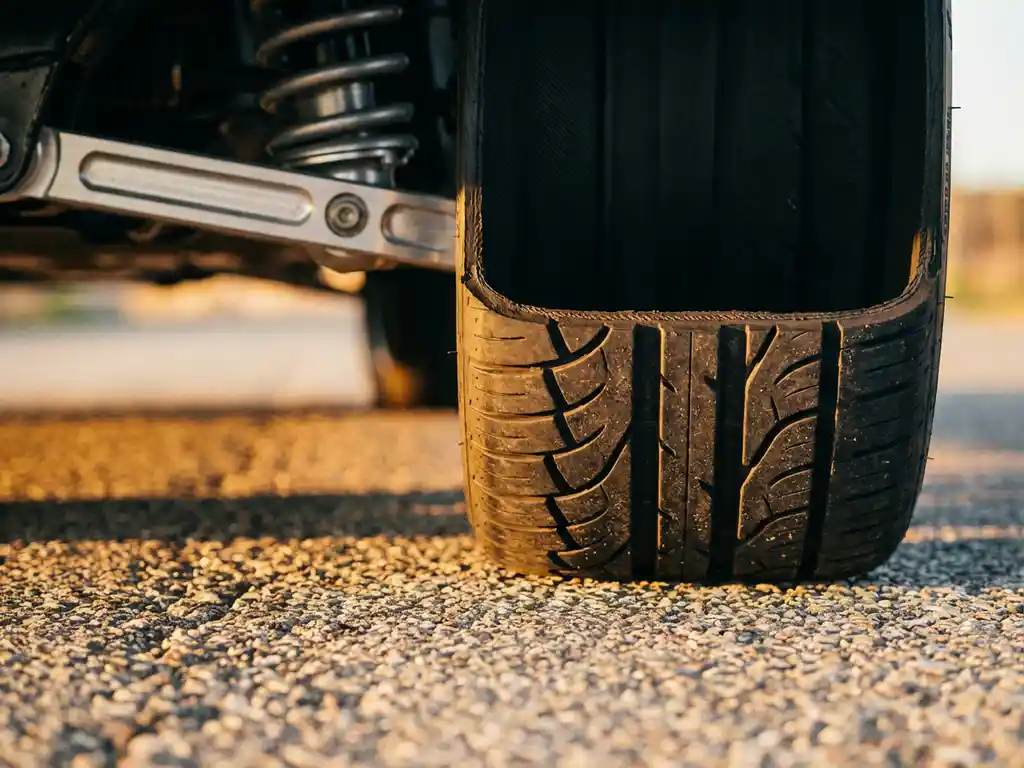
The relationship between suspension and the tyre contact patch is fundamental to vehicle performance, safety, and handling. Your suspension system directly controls how much of your tyre’s surface area maintains contact with the road, affecting everything from grip levels to braking distances. Understanding this connection helps explain why quality suspension tuning can transform how your car feels and performs on both street and track.
Modern suspension systems must balance multiple competing demands while maintaining optimal tyre contact. When suspension geometry is properly calibrated, it maximizes the contact patch under various driving conditions, ensuring consistent grip and predictable handling.
What is a tyre contact patch and why does it matter?
A tyre contact patch is the area of the tyre tread that physically touches the road surface at any given moment. This contact area, typically about the size of your hand for passenger cars, is the only connection between your vehicle and the road, making it critical for acceleration, braking, cornering, and overall vehicle control.
The size and shape of the contact patch directly influence your vehicle’s grip levels and handling characteristics. A larger, more evenly distributed contact patch provides better traction for acceleration and shorter braking distances. The contact patch also affects tyre wear patterns, with uneven contact leading to premature or irregular wear that reduces tyre life and performance.
Several factors determine contact patch characteristics, including tyre pressure, vehicle weight distribution, suspension geometry, and dynamic loading conditions. When these elements work together optimally, the contact patch remains stable and maximizes the available grip from your tyres across different driving scenarios.
How does suspension geometry affect the tyre contact patch?
Suspension geometry controls the tyre contact patch by determining the angle at which the tyre meets the road surface. Key geometric factors include camber angle, toe settings, and caster angle, all of which influence how evenly the tyre tread contacts the road and how this contact changes during vehicle movement.
Camber angle has the most direct impact on contact patch distribution. Negative camber tilts the top of the wheel inward, which can improve cornering grip by maintaining better contact during body roll. However, excessive negative camber reduces the contact patch during straight-line driving, potentially compromising braking performance and causing uneven tyre wear on the inner edge.
Toe settings affect how the tyre rolls and contacts the road surface. Incorrect toe alignment creates scrubbing forces that reduce the effective contact patch and cause rapid tyre wear. Proper toe alignment ensures the tyre rolls straight and maintains optimal contact with the road surface.
Suspension geometry changes dynamically as the vehicle moves through its travel range. Well-designed suspension systems maintain favourable geometry throughout suspension travel, preserving good contact patch characteristics even when the suspension is compressed or extended during driving.
Browse Products
Shock absorbers, springs, camber plates, air jacks and more. Explore the full range.
Custom Suspension
Every shock absorber built to your exact car, discipline and driving style. Nothing off the shelf.
Get in Touch
Have a question or a specific project? Our engineers are ready to help, no obligation.
What happens to the contact patch during cornering and braking?
During cornering and braking, dynamic forces transfer vehicle weight and alter tyre contact patch distribution. Weight transfer reduces the contact patch on unloaded wheels while increasing it on loaded wheels, creating an imbalance that affects overall grip and vehicle stability.
When cornering, lateral forces cause the vehicle body to roll, transferring weight to the outside wheels. This weight transfer increases the contact patch on the outside tyres while reducing it on the inside tyres. The suspension system must manage this transfer to maintain adequate contact on all wheels and prevent the inside wheels from losing grip entirely.
During braking, weight transfers forward, increasing the contact patch on the front tyres while reducing it on the rear. This forward weight transfer is why front brakes typically handle more braking force than rear brakes. However, excessive weight transfer can overload the front contact patch or cause the rear wheels to lose contact and lock up.
Acceleration creates the opposite effect, transferring weight rearward and increasing the rear contact patch while reducing the front. This weight transfer helps rear-wheel-drive vehicles put power down effectively but can cause front-wheel-drive vehicles to lose traction at the driven wheels.
How do shock absorbers control the tyre contact patch?
Shock absorbers control the tyre contact patch by managing wheel movement and maintaining consistent tyre-to-road contact during dynamic driving conditions. They dampen oscillations that would otherwise cause the wheel to bounce or lose contact with the road surface, ensuring the contact patch remains stable and effective.
When a wheel encounters a road irregularity, the spring compresses or extends to absorb the impact. Without proper damping control, the spring would continue oscillating, causing the wheel to bounce and repeatedly lose contact with the road. Quality shock absorbers prevent these oscillations, keeping the tyre firmly planted and maintaining consistent contact patch pressure.
Damping characteristics directly affect how quickly the suspension responds to changing conditions. Properly tuned damping allows the suspension to react quickly to road inputs while preventing excessive movement that would disrupt the contact patch. This balance is crucial for maintaining grip during rapid direction changes or over uneven surfaces.
The relationship between spring rates and damping also influences contact patch control. Springs support the vehicle weight and determine how the suspension moves, while dampers control the speed and character of that movement. When these components work together harmoniously, they maintain optimal contact patch characteristics across all driving conditions.
How Intrax Racing helps with suspension optimization
We help optimize your vehicle’s tyre contact patch through our custom suspension solutions, which are specifically calculated for your vehicle and driving requirements. Our approach ensures that your suspension geometry and damping characteristics work together to maximize contact patch effectiveness across all driving conditions.
Our custom suspension optimization includes:
- Precise geometry calculations based on your vehicle specifications and intended use
- Custom damping curves that maintain optimal contact patch control
- Spring rate selection that balances comfort with performance requirements
- Integration of all suspension components for maximum effectiveness
With nearly 50 years of motorsport experience, we understand how suspension affects the tyre contact patch at the highest levels of performance. Every custom shock absorber we build is designed to maintain optimal contact patch characteristics, whether you’re driving on the street, enjoying track days, or competing in motorsport. Contact us to discuss how we can optimize your suspension for maximum tyre contact patch effectiveness.
Browse Products
Shock absorbers, springs, camber plates, air jacks and more. Explore the full range.
Custom Suspension
Every shock absorber built to your exact car, discipline and driving style. Nothing off the shelf.
Get in Touch
Have a question or a specific project? Our engineers are ready to help, no obligation.