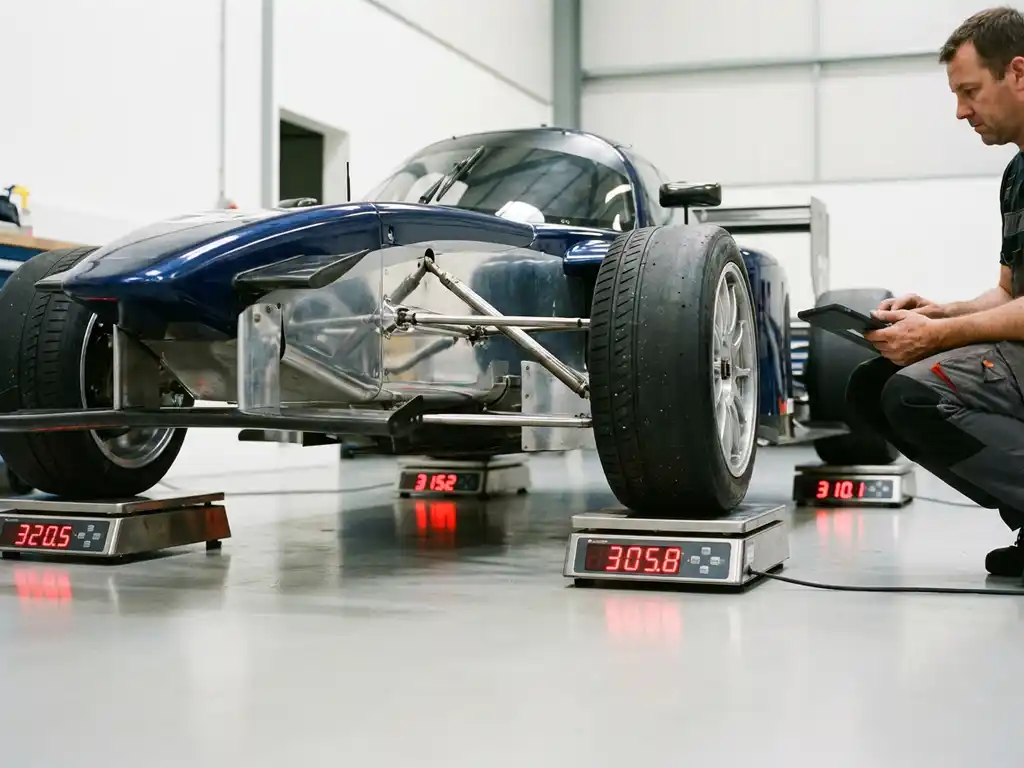
Corner weighting is a critical suspension-tuning technique that can dramatically transform your car’s handling. While many drivers focus on obvious modifications like tires or brakes, the way weight is distributed across your vehicle’s four corners plays a fundamental role in how predictably and safely your car behaves on the road or track.
Understanding corner weighting becomes essential when you’re serious about optimizing your vehicle’s performance—whether for spirited street driving, track days, or competitive motorsport. This precision tuning method can mean the difference between a car that feels balanced and confident through corners and one that exhibits unpredictable handling traits.
What is corner weighting and how does it work?
Corner weighting is the process of measuring and adjusting the weight distribution at each of your vehicle’s four wheels to achieve optimal balance and handling. This technique involves placing scales under each wheel to determine how much weight each corner supports, then making suspension adjustments to redistribute weight as needed.
The process works by using adjustable suspension components to change how weight is carried across the chassis. When you adjust springs and dampers, you’re essentially changing the vehicle’s stance and how forces are distributed during acceleration, braking, and cornering. Professional corner weighting typically targets specific weight-distribution percentages based on the vehicle’s intended use.
Most performance applications target a cross-weight percentage between 50% and 52%, meaning the combined weight of the front-left and rear-right wheels should equal the combined weight of the front-right and rear-left wheels. This diagonal balance helps ensure consistent handling when turning both left and right.
Why is corner weighting important for car handling?
Corner weighting directly affects your vehicle’s predictability, safety, and performance by ensuring balanced weight transfer during dynamic driving situations. Proper weight distribution eliminates handling inconsistencies that can make a car feel unstable or unpredictable through corners.
When corner weights are unbalanced, your vehicle may exhibit several problematic behaviors. The car might pull to one side under braking, feel loose or tight in corners depending on the direction of the turn, or show inconsistent grip levels between left and right turns. These characteristics not only reduce performance but can also create safety concerns during emergency maneuvers.
Balanced corner weights ensure that each tire carries an optimal load, maximizing the contact patch and the grip available from your tires. This becomes particularly crucial when using high-performance tires or competing in motorsport, where every fraction of available grip translates directly into lap-time improvements and increased safety margins.
Browse Products
Shock absorbers, springs, camber plates, air jacks and more. Explore the full range.
Custom Suspension
Every shock absorber built to your exact car, discipline and driving style. Nothing off the shelf.
Get in Touch
Have a question or a specific project? Our engineers are ready to help, no obligation.
When do you need corner weighting done?
Corner weighting becomes necessary whenever you’ve made significant suspension modifications, experienced handling issues, or are preparing a vehicle for competitive use. Most street cars benefit from corner weighting after installing adjustable suspension systems or making substantial changes to ride height.
Several specific scenarios warrant professional corner weighting. If you’ve recently installed coilover suspension, lowered your vehicle significantly, or added weight-altering modifications like a roll cage or racing seats, corner weighting helps restore optimal balance. Additionally, if your car exhibits directional handling differences or unusual tire-wear patterns, improper corner weights might be the underlying cause.
Motorsport applications almost always require corner weighting as part of a comprehensive setup process. Race cars, track-day vehicles, and high-performance street cars operating near their limits depend on precise weight distribution to achieve consistent, predictable handling that allows drivers to push confidently toward the vehicle’s performance envelope.
What’s the difference between corner weighting and wheel alignment?
Corner weighting focuses on weight distribution across the vehicle’s four corners, while wheel alignment adjusts the angles at which the wheels contact the road surface. These are complementary but distinct suspension-tuning processes that address different aspects of vehicle dynamics.
Wheel alignment involves adjusting camber, caster, and toe angles to optimize tire contact patches and steering characteristics. This process helps ensure that tires wear evenly and that the vehicle tracks straight without pulling to either side. Alignment primarily affects tire longevity, straight-line stability, and steering response.
Corner weighting, conversely, addresses how the vehicle’s mass is distributed and how weight transfers during dynamic situations. While alignment optimizes how tires meet the road, corner weighting optimizes how much load each tire carries. Both processes work together to create a well-balanced, predictable vehicle that maximizes tire performance and handling consistency.
How much does corner weighting cost and is it worth it?
Corner-weighting costs vary significantly based on your location, the complexity of your suspension system, and whether additional adjustments are needed. The investment is worthwhile when you consider the improvements in handling predictability, safety, and tire performance that proper weight distribution provides.
The value proposition extends beyond immediate performance gains. Properly balanced corner weights help ensure even tire wear, potentially extending tire life and reducing long-term costs. For vehicles used in motorsport or aggressive driving applications, corner weighting can help prevent costly incidents caused by unpredictable handling.
Consider corner weighting essential rather than optional if you’ve invested in performance suspension components. Without proper setup, even the highest-quality adjustable suspension systems cannot deliver their full potential. The cost of corner weighting typically represents a small fraction of most suspension upgrades while unlocking the full performance benefit of your investment.
How Intrax Racing helps with corner weighting optimization
We understand that achieving perfect corner balance requires more than adjustable components—it demands suspension systems designed for precise adjustability and supported by professional setup expertise. Our custom-built shock absorbers provide the fine-tuning capabilities necessary for optimal corner-weighting results.
Our approach to corner-weighting optimization includes:
- Custom shock absorbers calculated specifically for your vehicle’s weight distribution and intended use
- Precise adjustment capabilities that allow for fine-tuning weight distribution
- Professional consultation to determine optimal corner-weight targets for your application
- Ongoing support to maintain and adjust your setup as needed
Whether you’re preparing a track car, optimizing a street-performance vehicle, or building a competitive race car, our expertise in suspension dynamics ensures your corner-weighting efforts deliver maximum results. Contact us to discuss how our custom suspension solutions can help you achieve the perfectly balanced setup your vehicle deserves.
Browse Products
Shock absorbers, springs, camber plates, air jacks and more. Explore the full range.
Custom Suspension
Every shock absorber built to your exact car, discipline and driving style. Nothing off the shelf.
Get in Touch
Have a question or a specific project? Our engineers are ready to help, no obligation.