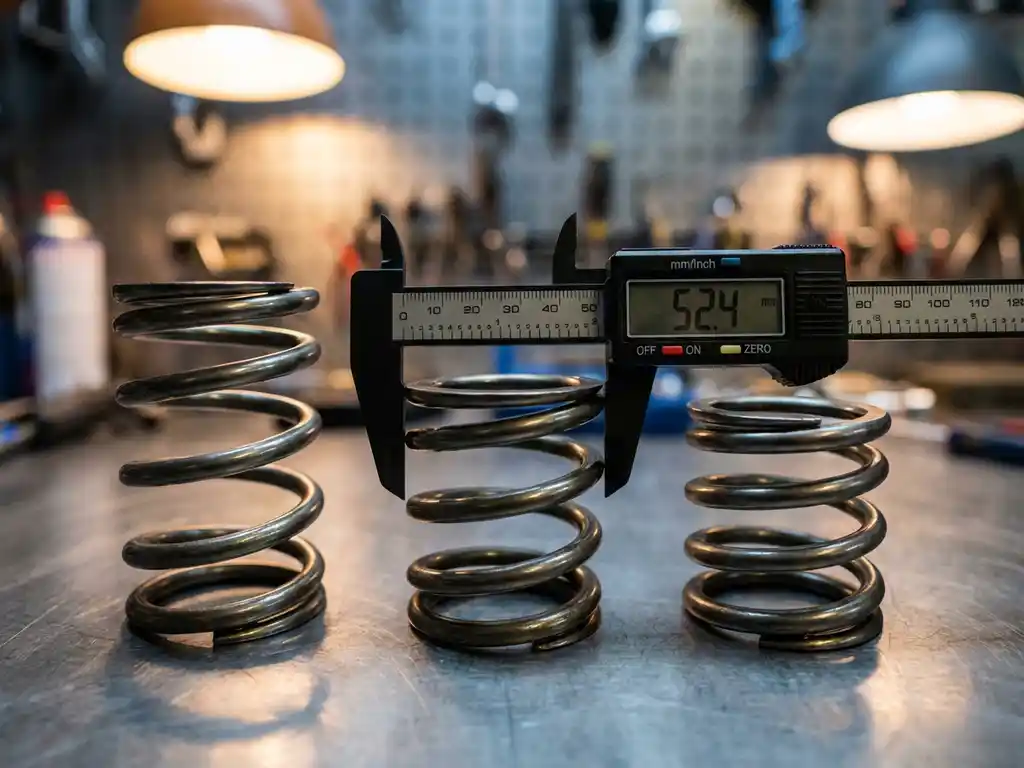
Selecting the right spring rate for your car is one of the most critical decisions in suspension tuning. The spring rate determines how your vehicle responds to road surfaces, cornering forces, and weight transfer, directly affecting both handling performance and ride comfort. Understanding spring rates helps you make informed decisions about your suspension setup.
Many drivers struggle with spring rate selection because they rely on generic recommendations rather than considering their specific vehicle and driving needs. The ideal spring rate balances your car’s weight distribution, intended use, and personal preferences for comfort versus performance.
What is spring rate, and why does it matter for your car?
Spring rate measures how much force is required to compress a spring by one unit of distance, typically expressed in pounds per inch (lb/in) or kilograms per millimeter (kg/mm). A higher spring rate means the spring is stiffer and requires more force to compress, while a lower spring rate indicates a softer spring that compresses more easily.
Spring rate directly affects your vehicle’s handling characteristics and ride quality. Stiffer springs reduce body roll during cornering and provide better control over weight transfer, improving handling precision. However, they also transmit more road imperfections to the cabin, potentially reducing comfort. Softer springs improve ride comfort by absorbing road irregularities but may allow excessive body movement during aggressive driving.
Spring rate also influences your car’s natural frequency, which determines how quickly the vehicle settles after hitting a bump or during weight transfer. This frequency must match your shock absorbers’ damping characteristics to achieve optimal performance. When spring rate and damping work together properly, you can improve handling while maintaining comfort.
How do you calculate the right spring rate for your vehicle?
Calculating the correct spring rate requires considering your vehicle’s weight, desired ride frequency, and intended use. The basic calculation starts with determining the natural frequency you want to achieve, typically between 1.0 and 1.5 Hz for street cars and 1.5 to 3.0 Hz for track vehicles.
The formula involves your vehicle’s corner weight (total weight divided by four, adjusted for weight distribution) and your target frequency. A common starting point for street applications is to multiply your corner weight by 0.7 to 1.0 for the front springs and 0.6 to 0.9 for the rear springs. For example, if your front corner weight is 800 pounds, a spring rate between 560 and 800 lb/in would be appropriate for street use.
However, this calculation must account for additional factors, including your car’s motion ratio, which varies based on suspension geometry. The motion ratio determines how much the spring compresses relative to wheel travel. Modern vehicles often have motion ratios between 0.6 and 0.9, meaning the spring compresses less than the wheel moves, effectively multiplying the spring rate’s effect at the wheel.
Browse Products
Shock absorbers, springs, camber plates, air jacks and more. Explore the full range.
Custom Suspension
Every shock absorber built to your exact car, discipline and driving style. Nothing off the shelf.
Get in Touch
Have a question or a specific project? Our engineers are ready to help, no obligation.
What’s the difference between linear and progressive spring rates?
Linear springs maintain a constant spring rate throughout their compression range, meaning they require the same additional force for each increment of compression. Progressive springs have a variable spring rate that increases as the spring compresses, starting softer and becoming stiffer under greater loads.
Linear springs provide predictable, consistent handling characteristics because their response remains constant regardless of compression. This predictability makes them preferred for racing applications where consistent behavior is crucial. The linear response allows drivers to better anticipate how the car will react to steering inputs and road conditions.
Progressive springs offer advantages for street driving by providing a softer initial rate for comfort over small bumps while becoming stiffer under heavier loads, such as cornering or braking. This design helps maintain ride quality during normal driving while providing additional support when needed. The variable rate can help control excessive suspension travel without requiring extremely stiff springs for normal driving conditions.
Should you choose stiffer or softer springs for better handling?
Stiffer springs generally improve handling by reducing body roll, minimizing weight transfer, and providing better control over suspension movement during cornering and braking. However, the optimal spring stiffness depends on your driving style, road conditions, and comfort requirements rather than simply choosing the stiffest option available.
Excessively stiff springs can actually hurt handling by reducing tire contact with the road surface over uneven pavement. When springs are too stiff, the wheels cannot follow road contours effectively, leading to reduced grip and unpredictable handling. The key is finding a balance: springs stiff enough to control body movement, yet compliant enough to maintain tire contact.
For street driving, moderately stiffer springs than stock often provide the best compromise between improved handling and maintained comfort. Track-focused applications can benefit from significantly stiffer springs, but only when paired with appropriate shock absorbers and when comfort is less important than maximum performance. The spring rate must also match your tires’ capabilities and suspension geometry to achieve optimal results.
How does vehicle weight affect spring rate selection?
Vehicle weight directly determines the minimum spring rate required to support the car and achieve proper ride height. Heavier vehicles need stiffer springs to prevent excessive compression and maintain appropriate suspension geometry, while lighter vehicles can use softer springs for the same performance characteristics.
Weight distribution between the front and rear axles also influences spring rate selection. Most vehicles carry more weight over the front axle due to engine placement, requiring different spring rates front to rear. Front-to-rear weight distribution typically ranges from 50/50 in well-balanced sports cars to 60/40 or more in front-heavy vehicles, necessitating proportionally different spring rates.
Changes in vehicle weight, such as adding heavy audio equipment or removing interior components, require spring rate adjustments to maintain optimal performance. Even passenger weight can affect spring rate requirements, which is why custom suspension solutions consider the vehicle’s typical loading conditions. Weight changes also affect the vehicle’s center of gravity, potentially requiring different spring rate ratios between the front and rear to maintain proper balance.
How Intrax Racing helps with spring rate selection
We provide comprehensive spring rate analysis and custom spring solutions tailored to your specific vehicle and driving requirements. Our engineers calculate optimal spring rates based on your car’s weight distribution, suspension geometry, intended use, and personal preferences for comfort versus performance.
Our custom approach includes:
- Detailed vehicle analysis, including weight distribution and motion ratios
- Calculation of optimal spring rates for your specific driving style and use case
- Custom spring manufacturing to exact specifications
- Integration with properly matched shock absorber damping
- Complete suspension packages that work together as a system
Rather than settling for generic spring rates that represent compromises across multiple applications, we build suspension systems specifically engineered for your vehicle and requirements. Contact us to discuss how we can develop the ideal spring rate solution for your car.
Browse Products
Shock absorbers, springs, camber plates, air jacks and more. Explore the full range.
Custom Suspension
Every shock absorber built to your exact car, discipline and driving style. Nothing off the shelf.
Get in Touch
Have a question or a specific project? Our engineers are ready to help, no obligation.
Related Articles
- What are common car suspension problems?
- Can incorrect preload damage your car suspension?
- Why do coilovers squeak and how do you fix it?
- Is an upside-down MacPherson worth it for your car?
- What actually changes when you get a custom spring and damper setup?
- What should you expect after installing coilovers?