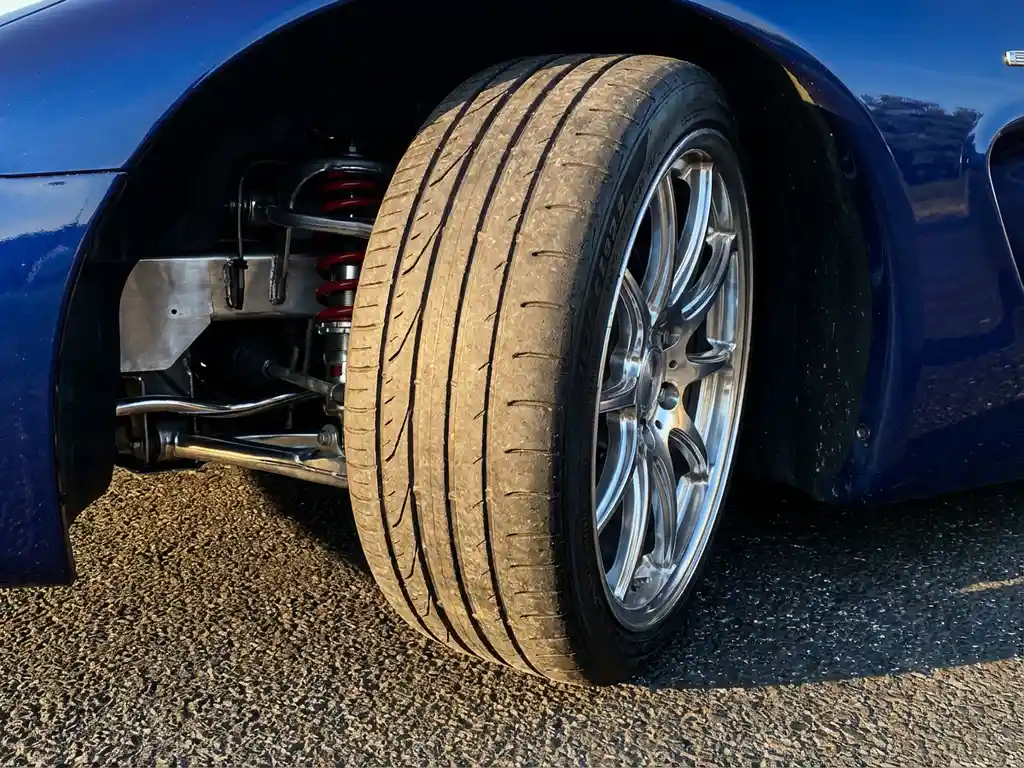
When you look at a car from the front or rear, you might notice that the wheels don’t sit perfectly vertical. This angle is called camber, and it’s one of the most important aspects of wheel alignment, dramatically affecting how your car handles, corners, and wears its tires. Understanding camber angle helps you make informed decisions about your vehicle’s suspension setup and performance.
Whether you’re dealing with uneven tire wear, poor cornering performance, or considering suspension modifications, camber plays a crucial role in your driving experience. From everyday street driving to high-performance racing applications, getting the camber angle right can transform how your vehicle behaves on the road.
What is camber, and how does it affect your car?
Camber is the angle of your wheels when viewed from the front or rear of the vehicle, measured in degrees from perfectly vertical. When the top of the wheel tilts inward toward the car, it’s called negative camber. When it tilts outward, it’s positive camber. Zero camber means the wheel sits perfectly upright.
This wheel angle directly influences how your tire’s contact patch meets the road surface. Proper camber helps ensure optimal tire contact under different driving conditions, affecting everything from straight-line stability to cornering grip. The camber angle works in conjunction with other suspension-geometry elements to determine your vehicle’s handling characteristics.
Most street cars come from the factory with slight negative camber, typically between 0.5 and 2 degrees. This factory setting provides a balance among tire wear, handling performance, and ride comfort for typical driving conditions.
What’s the difference between positive and negative camber?
Positive camber tilts the top of the wheel away from the vehicle, while negative camber tilts the top of the wheel toward the vehicle’s centerline. Each type serves different purposes and creates distinct handling characteristics depending on the application.
Positive camber was more common in older vehicles and is still used in some specific applications. It can improve straight-line stability and reduce steering effort, making it suitable for heavy-duty trucks or vehicles that primarily travel on straight roads. However, positive camber reduces cornering grip because it decreases the tire’s contact patch during turns.
Negative camber is preferred for most modern performance applications because it maximizes tire contact during cornering. When a vehicle turns, the outside wheels experience body roll that naturally reduces their contact with the road. Negative camber compensates for this effect, keeping more of the tire’s tread in contact with the pavement during aggressive cornering maneuvers.
Browse Products
Shock absorbers, springs, camber plates, air jacks and more. Explore the full range.
Custom Suspension
Every shock absorber built to your exact car, discipline and driving style. Nothing off the shelf.
Get in Touch
Have a question or a specific project? Our engineers are ready to help, no obligation.
How does camber affect tire wear and handling?
Camber angle significantly impacts both tire wear patterns and vehicle handling performance. Excessive camber in either direction causes uneven tire wear, while proper camber settings optimize both tire life and grip characteristics for your specific driving needs.
Too much negative camber causes the inside edge of the tire to wear faster than the outside edge. Conversely, excessive positive camber accelerates wear on the outside edge. Both scenarios reduce tire life and can create safety concerns as the tire’s structural integrity becomes compromised.
From a handling perspective, camber affects cornering grip, steering response, and overall vehicle balance. Moderate negative camber improves cornering performance by maintaining tire contact during turns, but it can reduce straight-line grip and increase rolling resistance. The key is finding the optimal balance between cornering performance and tire longevity based on your driving style and vehicle use.
Professional suspension terminology includes specific measurements that help determine the ideal camber settings for different applications, ensuring both performance and tire wear remain within acceptable parameters.
Why do race cars use negative camber?
Race cars use aggressive negative camber settings, often between 3 and 8 degrees, to maximize the tire’s contact patch during high-speed cornering, when lateral forces are extreme. This aggressive setup prioritizes cornering grip over tire longevity, since race tires are designed for maximum performance rather than extended wear.
During racing conditions, vehicles experience significant body roll and lateral load transfer that would cause standard camber settings to lose tire contact. Negative camber compensates for these forces, keeping the tire’s contact patch flat against the track surface even under extreme cornering loads.
Racing applications also benefit from the increased steering response that negative camber provides. This setup allows drivers to maintain precise control during high-speed maneuvers where split-second adjustments are critical. However, this comes at the cost of increased tire wear and reduced straight-line performance—trade-offs that are acceptable in competitive racing environments.
How do you know if your camber is wrong?
Several symptoms indicate incorrect camber settings, including uneven tire wear patterns, poor handling characteristics, and steering issues. The most obvious sign is tire wear on one edge of the tread, which develops gradually over thousands of miles of driving.
Visual inspection can reveal camber problems when you notice significant differences in tire wear between the inner and outer edges of the tread. Additionally, your vehicle might pull to one side during straight-line driving, or you might experience reduced grip during cornering maneuvers.
Professional wheel-alignment measurements provide precise camber readings, but you can perform basic checks at home. Park on level ground and observe your wheels from a distance. Significant camber issues are often visible to the naked eye, appearing as wheels that lean noticeably inward or outward from vertical.
Other indicators include increased road noise from the tires, vibration through the steering wheel, or handling that feels unstable or unpredictable under normal driving conditions.
How Intrax Racing helps with camber optimization
We specialize in creating custom suspension solutions that optimize camber angles for your specific vehicle and driving requirements. Our engineers calculate the ideal camber settings based on your car’s specifications, intended use, and personal preferences, ensuring optimal performance without compromising tire wear.
Our comprehensive approach includes:
- Custom shock absorber design that works with your desired camber settings
- Suspension geometry analysis to ensure all alignment angles work together harmoniously
- Performance testing to validate handling improvements and tire wear characteristics
- Ongoing support for adjustments and fine-tuning as your driving needs evolve
Rather than settling for generic suspension components that force compromises, our custom solutions ensure your camber settings enhance both performance and comfort. Every suspension system we build receives a unique identification number, allowing us to provide continued support and modifications throughout your vehicle’s lifetime.
Ready to optimize your vehicle’s camber and overall suspension performance? Contact our suspension experts to discuss your specific requirements and discover how custom engineering can transform your driving experience.
Browse Products
Shock absorbers, springs, camber plates, air jacks and more. Explore the full range.
Custom Suspension
Every shock absorber built to your exact car, discipline and driving style. Nothing off the shelf.
Get in Touch
Have a question or a specific project? Our engineers are ready to help, no obligation.
Related Articles
- What are common car suspension problems?
- How does rebound damping affect cornering stability on cars?
- How to adjust suspension for a lowered or lifted car?
- What is better, Upside down MacPherson or double wishbone?
- Is an upside-down MacPherson worth it for your car?
- What is the Difference between an upside-down MacPherson and a MacPherson strut?