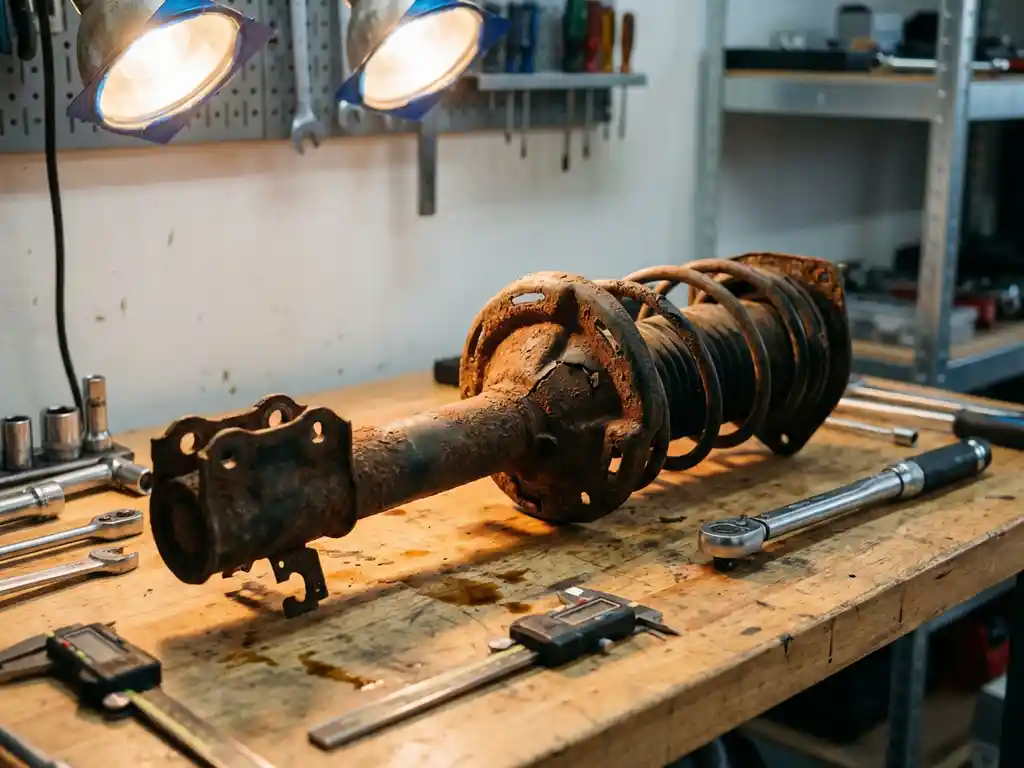
What are MacPherson struts, and how do they work?
MacPherson struts are a type of automotive suspension system that combines a shock absorber and a coil spring into a single structural unit, serving as both a damping element and a load-bearing component. This design connects directly to the wheel assembly and the vehicle’s body, providing both vertical support and lateral stability.
The system works by using a piston rod that moves within a cylinder filled with hydraulic fluid. When the wheel encounters road irregularities, the strut compresses and extends, forcing fluid through precisely calibrated valves to control the damping rate. The coil spring surrounding the strut supports the vehicle’s weight and provides the restoring force that returns the wheel to its normal position.
MacPherson struts are particularly popular because of their compact design and cost-effectiveness. Unlike more complex suspension systems, they require fewer mounting points and take up less space, making them ideal for front-wheel-drive vehicles where engine-bay space is limited. The strut essentially replaces the upper control arm found in other suspension designs, simplifying the overall assembly while maintaining effective wheel control.
What are the most common causes of MacPherson strut failure?
The most common causes of MacPherson strut failure include seal deterioration, internal component wear, external damage from road hazards, and structural stress from lateral forces during cornering. These failures typically develop gradually over time, although sudden damage can occur due to impacts or extreme driving conditions.
Seal failure is the primary cause of strut deterioration. The rubber seals that prevent hydraulic fluid from escaping become brittle with age and temperature cycling. Once the seals fail, the strut loses its damping ability as fluid leaks out, leading to poor ride quality and reduced vehicle control. Environmental factors such as road salt, debris, and extreme temperatures accelerate this degradation process.
Internal wear occurs as the piston and valving components experience millions of cycles during normal operation. Constant movement gradually wears down the precision-machined surfaces, causing increased internal friction and inconsistent damping performance. Additionally, contamination from failed seals can introduce particles that accelerate this wear process.
Lateral forces during cornering create significant stress in the MacPherson strut design. Because the piston rod serves as both a damping element and a structural component, bending forces can cause the rod to flex, disrupting smooth operation and potentially leading to premature failure. This structural limitation becomes more pronounced during performance driving or when carrying heavy loads.
Signs of failing MacPherson struts include visible fluid leakage around the strut body, excessive bouncing after hitting bumps, uneven tire wear patterns, and increased body roll during cornering. You may also notice knocking or clunking sounds when driving over rough surfaces, which can indicate internal component damage.
Browse Products
Shock absorbers, springs, camber plates, air jacks and more. Explore the full range.
Custom Suspension
Every shock absorber built to your exact car, discipline and driving style. Nothing off the shelf.
Get in Touch
Have a question or a specific project? Our engineers are ready to help, no obligation.
How can you tell if your MacPherson struts are failing?
Signs of failing MacPherson struts include visible fluid leakage around the strut body, excessive bouncing after hitting bumps, uneven tire wear patterns, and increased body roll during cornering. You may also notice knocking or clunking sounds when driving over rough surfaces, which can indicate internal component damage.
The bounce test provides a simple diagnostic method. Push down firmly on each corner of your vehicle and release. A healthy strut should allow the vehicle to return to its normal position with minimal additional bouncing. If the corner continues to bounce more than once or twice, the strut’s damping ability has likely deteriorated significantly.
Tire wear patterns can reveal strut problems before other symptoms become obvious. Look for cupping or scalloping on the tire tread, where irregular high and low spots develop across the tire surface. This occurs when failing struts allow excessive wheel movement, preventing consistent tire contact with the road surface.
Handling characteristics change noticeably as struts deteriorate. You might experience increased stopping distances, as worn struts reduce tire contact during braking. The vehicle may also feel less stable in crosswinds or when changing lanes, and steering response may become less precise due to inconsistent wheel positioning.
Why do MacPherson struts fail faster than other suspension components?
MacPherson struts fail faster than other suspension components because they serve dual functions as both damping elements and structural load-bearing members, subjecting them to more stress than specialized, single-purpose components. This combined role means they experience both the constant cycling of shock absorption and the lateral forces from steering and cornering.
The conventional MacPherson design places the piston rod under bending stress during cornering, as it must resist lateral forces while maintaining smooth damping action. Other suspension designs separate these functions, with dedicated control arms handling lateral loads while shock absorbers focus solely on damping. This division of labor typically results in longer component life for each element.
Seal exposure is another vulnerability unique to MacPherson struts. The seals are directly exposed to road contaminants, temperature extremes, and physical damage from debris. In contrast, shock absorbers in other suspension systems often benefit from greater protection from surrounding components or mounting locations that shield them from direct environmental exposure.
The integrated design also means that when any part of the MacPherson strut fails, the entire unit typically requires replacement. Other suspension systems allow individual component replacement, potentially extending overall system life through selective maintenance rather than complete unit replacement.
How long should MacPherson struts last before replacement?
MacPherson struts typically last between 50,000 and 100,000 miles under normal driving conditions, although this range varies significantly based on driving habits, road conditions, and vehicle usage patterns. Performance-oriented driving or harsh road conditions can reduce this lifespan considerably, while gentle driving on smooth roads may extend it.
Several factors influence strut longevity beyond simple mileage. Frequent driving on rough or unpaved roads accelerates wear through increased cycling and potential impact damage. Climate conditions also play a role, with extreme temperature variations causing faster seal degradation and internal component wear. Vehicles that regularly carry heavy loads or are used for towing experience additional stress that shortens strut life.
Regular maintenance can help maximize strut lifespan. Keeping the vehicle properly aligned reduces uneven loading on the struts, while maintaining appropriate tire pressure ensures optimal load distribution. However, unlike some suspension components, MacPherson struts cannot be serviced or rebuilt in most cases, making replacement the primary maintenance option.
Rather than relying solely on mileage intervals, monitor your struts’ performance characteristics. The symptoms described earlier provide more reliable indicators of replacement needs than arbitrary mileage targets. Some struts may require replacement at 40,000 miles due to severe service conditions, while others might perform adequately beyond 100,000 miles with careful use.
How Intrax Racing helps with MacPherson strut solutions
We address MacPherson strut limitations through our advanced suspension technology and custom engineering approach. Our upside-down MacPherson design eliminates the primary weakness of conventional struts by inverting the load path, making the larger outer tube the structural element while protecting the piston rod from bending forces.
Our custom-built solutions offer several key advantages:
- Elimination of piston-rod bending stress through an inverted design architecture
- Consistent damping performance regardless of lateral forces or cornering loads
- Reduced camber change under dynamic conditions for improved tire contact
- Extended service life through optimized load distribution and reduced component stress
- Personalized tuning based on your specific vehicle requirements and driving style
With nearly 50 years of suspension expertise, we build each damper specifically for your application rather than offering one-size-fits-all solutions. This approach ensures optimal performance and longevity while addressing the inherent limitations of conventional MacPherson strut designs. Contact us to discuss how our advanced suspension technology can solve your MacPherson strut challenges and deliver superior performance for your specific needs.
Browse Products
Shock absorbers, springs, camber plates, air jacks and more. Explore the full range.
Custom Suspension
Every shock absorber built to your exact car, discipline and driving style. Nothing off the shelf.
Get in Touch
Have a question or a specific project? Our engineers are ready to help, no obligation.