Adjusting ride height is one of the most common suspension modifications, but many enthusiasts worry about disrupting their vehicle’s carefully engineered geometry. The good news is that with the right techniques and understanding, you can achieve your desired ride height while maintaining optimal suspension geometry and handling characteristics.
Modern suspension systems offer several methods for adjusting ride height without compromising the geometric relationships between components. Understanding these methods—and when to use them—is crucial for maintaining both performance and safety while achieving your desired stance.
What is ride height and why does it matter for suspension geometry?
Ride height is the vertical distance between your vehicle’s chassis and the ground, typically measured from the wheel center to the fender arch. This measurement directly affects suspension geometry because it determines the operating angles of control arms, tie rods, and other suspension components that control wheel movement and alignment.
Proper ride height maintains the suspension’s intended geometry, ensuring optimal tire contact patches, predictable handling, and even tire wear. When suspension components operate within their intended range of motion, they maintain the correct camber curves, bump-steer characteristics, and roll-center positions that engineers designed for optimal performance.
Changes in ride height alter the static positions of suspension links, which can shift the vehicle’s roll center, affect camber gain during cornering, and introduce unwanted bump steer. These geometric changes become more pronounced with extreme ride height modifications, potentially compromising both handling and tire wear patterns.
What happens to suspension geometry when you change ride height?
Lowering or raising ride height moves suspension components away from their designed operating positions, altering critical geometric relationships. Control arms operate at different angles, tie-rod geometry changes, and the suspension’s instant centers shift, affecting handling characteristics and tire wear patterns.
When you lower a vehicle significantly, control arms angle downward more sharply, often resulting in increased negative camber and altered camber curves during suspension travel. This can improve cornering grip but may cause uneven tire wear and reduced straight-line stability. The roll center also typically drops, which can increase body roll and affect weight-transfer characteristics.
Raising ride height creates the opposite effects, with control arms angling upward and potentially reducing negative camber. While this might improve straight-line stability, it can reduce cornering performance and create handling characteristics different from what the manufacturer intended. Extreme height increases can also stress CV joints and driveline components beyond their optimal operating angles.
Browse Products
Shock absorbers, springs, camber plates, air jacks and more. Explore the full range.
Custom Suspension
Every shock absorber built to your exact car, discipline and driving style. Nothing off the shelf.
Get in Touch
Have a question or a specific project? Our engineers are ready to help, no obligation.
How do threaded-body coilovers maintain geometry during adjustment?
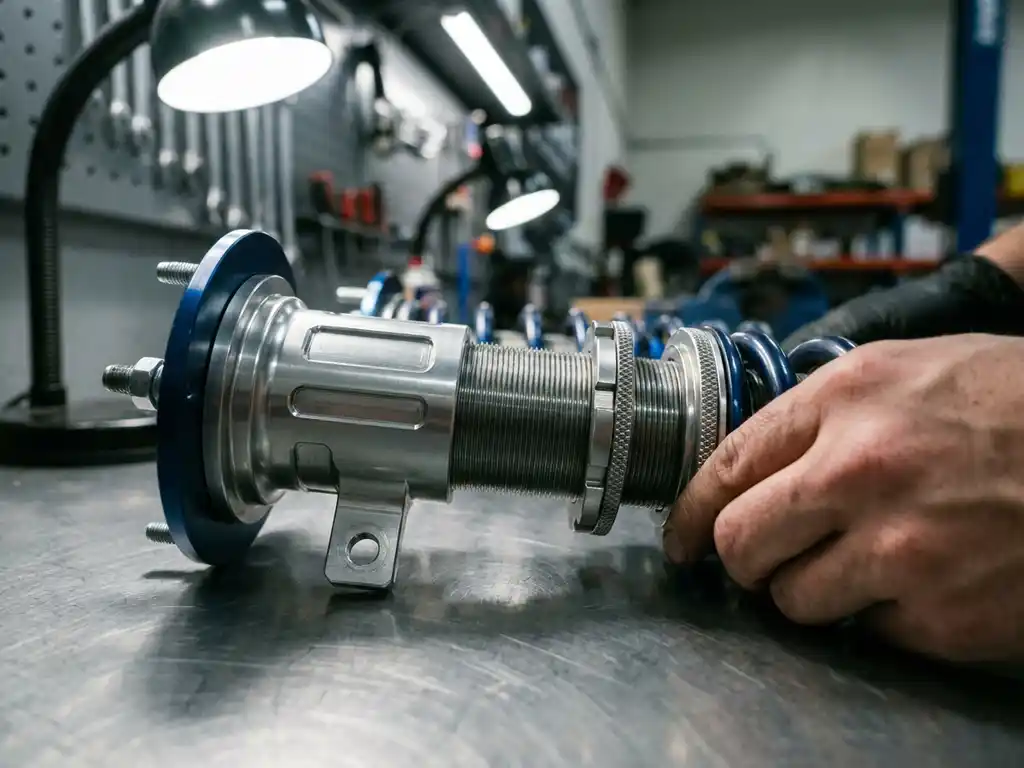
Threaded-body coilovers maintain suspension geometry by adjusting ride height through spring preload rather than changing the shock absorber’s mounting position. The threaded body allows the spring perch to move up and down the shock body while keeping the shock’s attachment points in their original locations.
This design preserves the geometric relationships between suspension components because the shock absorber’s upper and lower mounting points remain unchanged. Only the spring’s compressed length varies, which affects ride height without altering control arm angles, tie-rod positions, or other critical suspension-geometry elements.
The adjustment process involves rotating threaded collars to compress or decompress the spring, changing the vehicle’s static ride height while maintaining the shock absorber’s stroke and damping characteristics. This method allows for significant ride height adjustments while keeping suspension geometry within acceptable parameters.
What’s the difference between adjusting preload and changing ride height?
Adjusting preload changes how much force is applied to compress the spring when the vehicle is at rest, while changing ride height alters the vehicle’s overall stance. Preload adjustment affects spring tension without necessarily changing ride height, whereas ride height changes can be achieved through various methods, including preload adjustment.
Spring preload determines how much the spring is compressed when supporting the vehicle’s weight at rest. Increasing preload compresses the spring more, potentially raising ride height, while decreasing preload allows the spring to extend more, potentially lowering the vehicle. However, preload changes primarily affect how the suspension responds to initial movement rather than drastically altering static height.
True ride height adjustment through preload maintains suspension geometry because it doesn’t change mounting points or component positions. This differs from methods like cutting springs or using shorter springs, which can dramatically alter suspension geometry by changing the operating positions of control arms and other components.
How do you properly adjust ride height with geometry-neutral methods?
Proper, geometry-neutral ride height adjustment involves using threaded coilover systems and following systematic measurement and adjustment procedures. Begin by measuring current ride height at all four corners, then make incremental adjustments while monitoring suspension component positions and maintaining proper wheel alignment.
Start by placing the vehicle on level ground and measuring from the wheel center to the fender arch at each corner. When using quality coilover systems, jack the vehicle up at chassis points to allow the wheels to fully extend, then mark the adjustment collars to track the turns made during adjustment.
The adjustment process requires:
- Cleaning and lightly lubricating adjustment threads
- Making equal adjustments on the left and right sides
- Settling the suspension by bouncing it or driving the vehicle
- Re-measuring and fine-tuning until the desired height is achieved
- Checking wheel alignment after final adjustments
Always prioritize helper-spring preload settings before adjusting the main springs, as this ensures proper suspension operation throughout the adjustment range.
When should you consider geometry correction after ride height changes?
Geometry correction becomes necessary when ride height changes exceed the suspension’s designed operating range or when handling characteristics noticeably deteriorate. Generally, height changes beyond 30–40 mm from stock may require geometry modifications to maintain optimal performance and tire wear patterns.
Signs that geometry correction is needed include uneven tire wear, increased bump steer, poor straight-line stability, or handling characteristics that feel significantly different from stock. Professional alignment measurements can reveal whether camber, caster, or toe settings have moved outside acceptable ranges due to ride height changes.
Extreme lowering often requires adjustable control arms, camber plates, or other geometry-correction components to restore proper alignment angles. Similarly, significant ride height increases may necessitate different suspension components to maintain proper CV-joint angles and driveline operation.
How Intrax Racing helps with ride height adjustment
We specialize in creating custom suspension solutions that allow precise ride height adjustment while maintaining optimal geometry for your specific vehicle and driving requirements. Our approach considers your vehicle’s unique characteristics and intended use to deliver suspension systems that perform exactly as needed.
Our custom ride height solutions include:
- Threaded-body shock absorbers designed for your specific vehicle and requirements
- Calculated spring rates that complement your desired ride height
- Geometry analysis to ensure optimal suspension performance
- Complete documentation and adjustment guidelines for your specific setup
Every system is built only after analyzing your vehicle data, modifications, and driving preferences, ensuring that your ride height adjustment enhances rather than compromises your vehicle’s performance. Contact us to discuss how we can create the perfect suspension solution for your ride height and performance goals.
Browse Products
Shock absorbers, springs, camber plates, air jacks and more. Explore the full range.
Custom Suspension
Every shock absorber built to your exact car, discipline and driving style. Nothing off the shelf.
Get in Touch
Have a question or a specific project? Our engineers are ready to help, no obligation.
Related Articles
- What happens to your geometry when you lower a car too much?
- What is the difference between a street coilover and a motorsport coilover?
- How do you adjust rebound damping for performance driving?
- How does weight affect suspension setup and spring rate choice?
- What suspension settings affect small bump compliance on cars?
- How do progressive springs improve ride quality on cars?