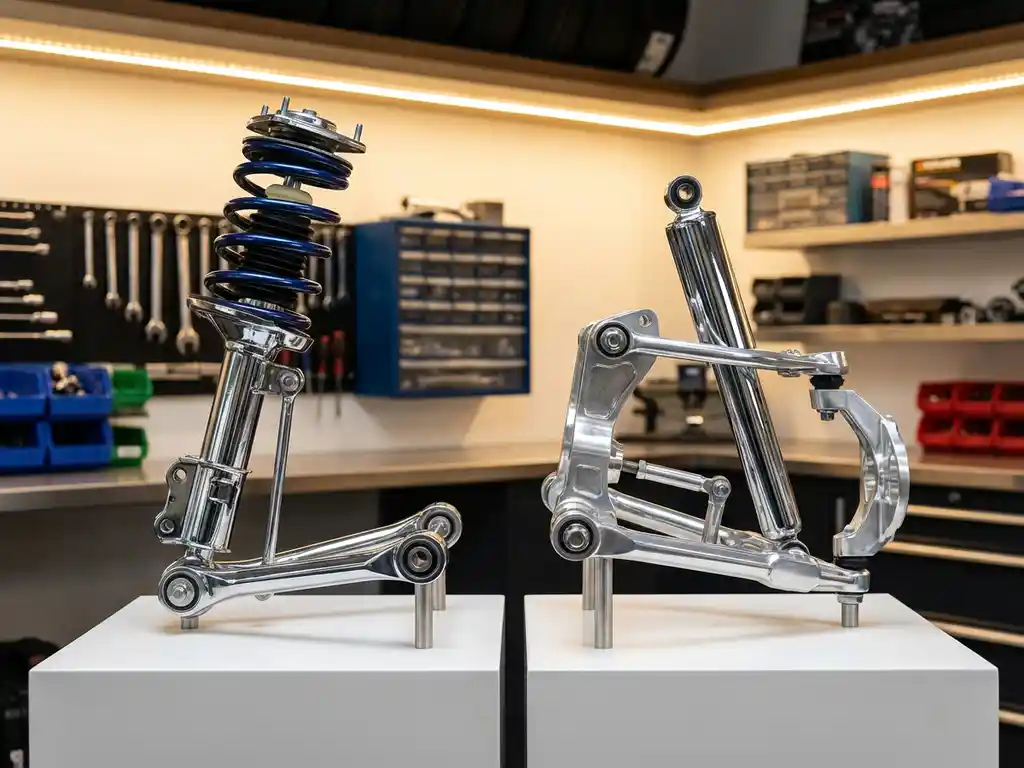
What is the difference between upside-down MacPherson and double wishbone suspension?
The primary difference lies in their structural design and load distribution: an upside-down MacPherson strut inverts the traditional strut configuration to reduce bending under lateral forces, while a double wishbone setup uses two separate control arms to manage wheel movement independently of the damper. Both are independent suspension systems, but they achieve wheel control through fundamentally different approaches.
In a conventional MacPherson strut, the piston rod serves as both the damping element and the primary structural component, making it vulnerable to bending stress during cornering. The upside-down MacPherson design addresses this weakness by making the larger outer tube the load-bearing element, while the piston rod remains protected inside. This inversion maintains damping consistency and reduces camber change under dynamic loads.
Double wishbone suspension, by contrast, separates the damping and structural functions entirely. Two wishbone-shaped control arms—upper and lower—manage wheel positioning, while the shock absorber focuses solely on damping. This separation allows engineers to optimize wheel geometry independently of damper placement, providing superior control over camber, caster, and toe angles throughout suspension travel.
How does upside-down MacPherson suspension work?
Upside-down MacPherson suspension works by inverting the traditional strut design so the larger outer tube becomes the primary structural element that connects to the wheel carrier, while the piston rod remains internal and protected from bending forces. This configuration maintains straight rod alignment throughout the damping stroke, preserving consistent damping performance regardless of cornering loads.
The key mechanical advantage emerges under dynamic conditions. In conventional MacPherson struts, lateral forces from cornering can cause the piston rod to bend, which introduces friction, disrupts damping consistency, and can lead to seal failure. The inverted design transfers these lateral loads to the much stronger outer tube, which has significantly greater resistance to bending due to its larger diameter and wall thickness.
During suspension compression and rebound, the piston rod moves freely within the protected outer tube without experiencing the bending stresses that compromise conventional struts. This results in more predictable damping characteristics, reduced friction, and improved reliability over the component’s service life. The design also minimizes camber change under load, keeping the wheel geometry stable and maintaining consistent tire contact with the road surface.
What are the advantages of double wishbone suspension?
Double wishbone suspension offers superior wheel-geometry control through its dual-arm design, allowing engineers to precisely manage camber, caster, and toe angles throughout suspension travel. This independent control of wheel positioning provides better maintenance of the tire contact patch, improved handling predictability, and reduced tire wear compared to strut-based systems.
The separation of structural and damping functions creates significant engineering flexibility. The shock absorber can be positioned optimally for packaging and performance without compromising wheel control, while the upper and lower wishbones can be designed with different lengths and angles to achieve specific handling characteristics. This flexibility makes double wishbone suspension particularly valuable in performance applications where precise wheel control is paramount.
Additional advantages include excellent durability under high loads, as forces are distributed across multiple mounting points rather than concentrated in a single strut assembly. The system also allows for more sophisticated anti-roll bar integration and provides better isolation of road noise and vibration. These benefits explain why double wishbone suspension remains the preferred choice for many high-performance vehicles and racing applications.
Which suspension is better for performance driving?
For ultimate performance driving, double wishbone suspension generally provides superior control due to its ability to maintain optimal wheel geometry throughout suspension travel and its flexibility in tuning. However, upside-down MacPherson can deliver excellent performance while offering packaging and cost advantages, making the choice dependent on specific performance priorities and constraints.
Double wishbone excels in track conditions where precise handling and consistent lap times are critical. The system’s ability to minimize camber change during body roll helps maintain the maximum tire contact patch, which is crucial for generating peak grip. The independent positioning of shock absorbers also allows for optimal damper placement and more sophisticated anti-roll bar configurations.
Upside-down MacPherson represents a compelling middle ground for performance applications. While it cannot match double wishbone’s ultimate geometric control, it eliminates the primary weakness of conventional struts under high lateral loads. For street-performance cars and many motorsport applications, a properly tuned upside-down MacPherson setup can deliver handling that approaches double wishbone performance while maintaining simpler packaging and lower complexity.
What are the disadvantages of each suspension type?
Upside-down MacPherson’s main disadvantages include inherent camber change during suspension travel and structural limitations compared to double wishbone systems, while double wishbone suspension suffers from increased complexity, higher costs, and greater packaging-space requirements. Both systems demand precise engineering to realize their potential benefits.
Upside-Down MacPherson Limitations
Despite its improvements over conventional struts, upside-down MacPherson still experiences some camber change during suspension compression and rebound, though significantly less than traditional MacPherson designs. The system also requires more sophisticated manufacturing than conventional struts, potentially increasing production costs. Additionally, the inverted design may present packaging challenges in some vehicle configurations, where the larger tube diameter at the top mount creates clearance issues.
Double Wishbone Drawbacks
Double wishbone suspension’s complexity translates into higher manufacturing costs and increased maintenance requirements due to multiple pivot points and bushings. The system demands significantly more packaging space, making it challenging to implement in compact vehicles or in vehicles where interior space is prioritized. The numerous connection points also create more potential failure modes, and achieving optimal performance requires careful attention to bushing selection and maintenance.
How Intrax Racing Helps with Custom Suspension Solutions
We specialize in creating custom suspension systems that maximize the potential of both upside-down MacPherson and double wishbone configurations for your specific vehicle and driving requirements. Rather than offering one-size-fits-all solutions, our approach involves calculating precise damping characteristics and spring rates tailored to your car’s weight distribution, intended use, and personal preferences.
Our custom suspension development process includes:
- Detailed analysis of your vehicle’s suspension geometry and load characteristics
- Custom damper valving optimized for your specific suspension type and driving style
- Matched spring selection that complements the damper characteristics
- Performance testing and refinement to ensure an optimal balance of handling and comfort
Whether you’re working with upside-down MacPherson or double wishbone suspension, our nearly 50 years of motorsport experience enables us to extract maximum performance from your chosen system. Contact us to discuss how we can develop a suspension solution that transforms your vehicle’s handling characteristics while maintaining the comfort you need for your intended use.