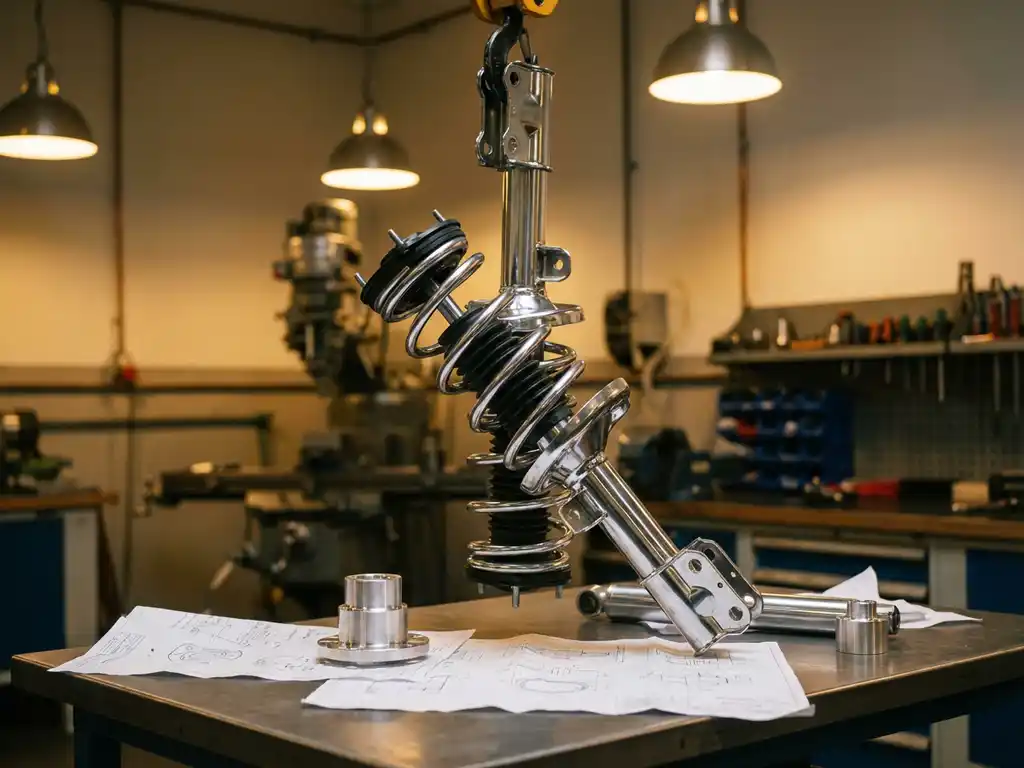
What is an upside-down MacPherson strut?
An upside-down MacPherson strut, also called an inverted MacPherson strut, is a suspension design in which the shock absorber’s piston rod is mounted at the bottom and connected to the wheel hub, while the cylinder body is fixed to the vehicle’s chassis at the top. This configuration reverses the traditional MacPherson strut arrangement.
In conventional MacPherson struts, the heavy cylinder body sits at the bottom near the wheel, with the thinner piston rod extending upward to the chassis mount. The inverted design flips this orientation completely. This suspension technology lowers the center of gravity of the unsprung mass, which includes all components that move with the wheel during suspension travel. The suspension terminology can be confusing, but understanding this fundamental difference helps explain why many performance vehicles adopt this configuration.
How does an upside-down MacPherson differ from a regular MacPherson strut?
The primary difference lies in the mounting orientation and weight distribution. In a regular MacPherson strut, the heavy shock absorber body is positioned at the bottom, while an inverted MacPherson strut places the lighter piston rod at the bottom and the heavier cylinder at the top, attached to the vehicle’s structure.
This design change affects several key aspects of suspension performance. The inverted configuration reduces unsprung weight, which is the mass that moves with the wheel and tire. Lower unsprung weight allows the suspension to respond more quickly to changes in the road surface, improving tire contact and overall handling precision. Additionally, the inverted design typically offers better structural rigidity because the larger-diameter cylinder body provides a more robust mounting point to the chassis. The shock absorber in inverted systems also tends to run cooler, since the cylinder body dissipates heat more effectively when mounted away from the wheel and brake components.
What are the benefits of upside-down MacPherson suspension?
Upside-down MacPherson suspension offers three main advantages: reduced unsprung weight, improved structural rigidity, and better heat management. These benefits translate directly into enhanced vehicle dynamics, more precise steering response, and more consistent damping performance under demanding conditions.
The reduced unsprung weight is perhaps the most significant benefit. When the heavy shock absorber body moves to the sprung side of the suspension, the wheel assembly becomes lighter and more responsive to road surface variations. This improved responsiveness enhances tire grip and provides better feedback to the driver. The structural advantages come from mounting the larger cylinder body to the chassis, creating a more rigid connection that reduces flex under load.
Heat dissipation is another crucial advantage of inverted suspension systems. The shock absorber cylinder, positioned away from the wheel well and brake components, operates in cooler conditions, maintaining more consistent damping characteristics during extended performance driving. This thermal management becomes especially important in motorsport applications, where suspension components face extreme operating conditions.
Browse Products
Shock absorbers, springs, camber plates, air jacks and more. Explore the full range.
Custom Suspension
Every shock absorber built to your exact car, discipline and driving style. Nothing off the shelf.
Get in Touch
Have a question or a specific project? Our engineers are ready to help, no obligation.
Why do high-performance cars use inverted MacPherson struts?
High-performance cars use inverted MacPherson struts because they provide superior dynamic response, better weight distribution, and more consistent performance under extreme driving conditions. Reduced unsprung weight and improved structural rigidity directly contribute to faster lap times and enhanced driver control.
Racing and performance applications demand suspension systems that can respond instantly to driver inputs and road surface changes. The lighter unsprung mass in inverted strut systems allows wheels to follow track irregularities more precisely, maintaining optimal tire contact patches. This improved contact translates into better braking performance, more predictable cornering behavior, and enhanced traction under acceleration.
High-performance vehicles also require durability under stress. Inverted struts typically feature larger-diameter components and more robust mounting systems, allowing them to withstand the increased loads generated by aggressive driving, aerodynamic downforce, and performance tires. Improved heat dissipation helps ensure that damping performance remains consistent even during extended track sessions or competitive racing scenarios.
How Intrax Racing Helps with Custom Inverted Suspension Solutions
We specialize in developing custom-made inverted MacPherson strut systems tailored to specific vehicles and driving requirements. Our approach ensures that each suspension system maximizes the benefits of inverted strut technology while addressing the unique characteristics of your particular application.
Our custom inverted suspension solutions include:
- Precise damping calibration based on vehicle weight distribution and intended use
- Custom valving designed for your specific driving style and performance goals
- Integration with existing vehicle systems while optimizing unsprung weight reduction
- Heat management solutions for consistent performance under demanding conditions
Every inverted strut system we build starts with a detailed analysis of your vehicle’s requirements and your performance objectives. This ensures that the suspension technology delivers measurable improvements in handling, comfort, and overall driving dynamics. Contact us to discuss how custom inverted MacPherson struts can transform your vehicle’s suspension performance.
Browse Products
Shock absorbers, springs, camber plates, air jacks and more. Explore the full range.
Custom Suspension
Every shock absorber built to your exact car, discipline and driving style. Nothing off the shelf.
Get in Touch
Have a question or a specific project? Our engineers are ready to help, no obligation.
Related Articles
- How do suspension linkages affect car front suspension performance?
- How much suspension travel do you need for performance car builds?
- When should you replace car tires?
- Why does my lowered car make a clunking noise?
- How do I know if my shocks are worn out after lowering?
- Why do some coilovers last longer than others?