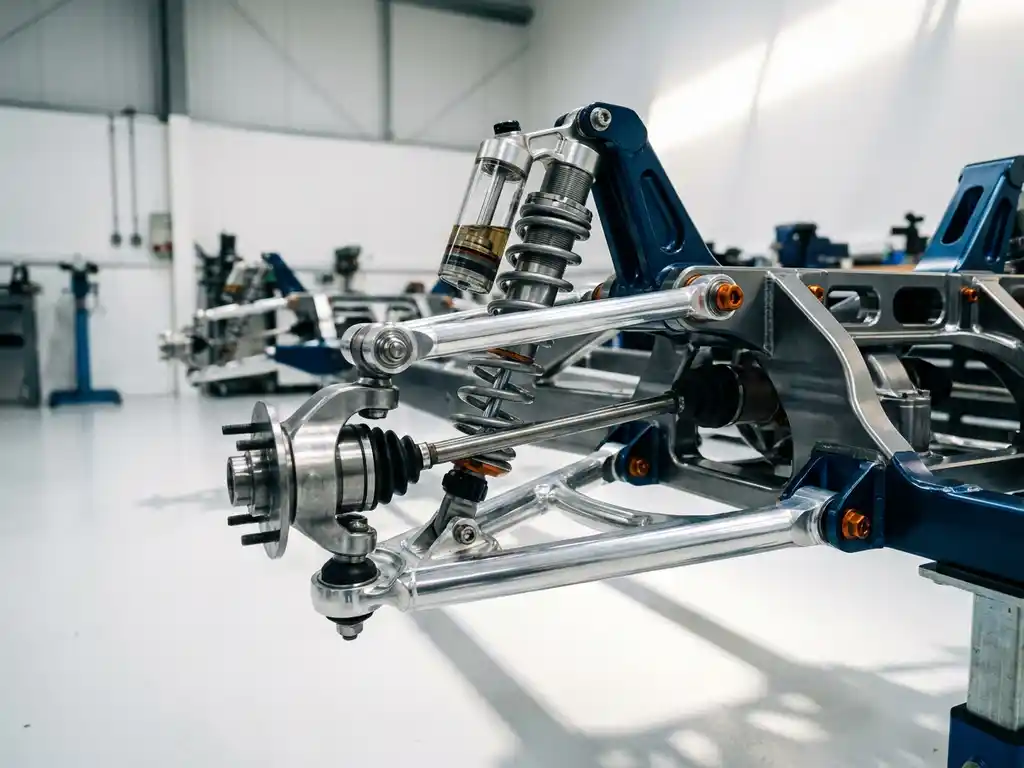
Suspension linkages directly control how rear wheels move relative to the vehicle body, determining wheel alignment angles, load distribution, and contact patch optimization during cornering, braking, and acceleration. The specific linkage design shapes handling characteristics, ride quality, and overall vehicle dynamics by managing camber changes, toe adjustments, and roll center positioning throughout the suspension’s travel range.
Modern rear suspension systems use various linkage configurations to balance performance demands with packaging constraints. Understanding these systems helps explain why suspension components must work together as an integrated package rather than as individual parts.
What types of suspension linkages are used in rear suspensions?
Rear suspension linkages fall into three main categories: trailing arms, lateral links, and multi-link systems that combine multiple connection points to control wheel movement. Each type offers different advantages for specific vehicle applications and performance requirements.
Trailing arm systems connect the wheel hub to the chassis through arms that extend longitudinally from the vehicle body. These simple systems excel in packaging efficiency and cost-effectiveness, making them popular in compact cars and some performance applications. Semi-trailing arms angle the pivot points to improve handling characteristics compared to pure trailing designs.
Lateral link systems use arms positioned perpendicular to the vehicle’s centerline to control side-to-side wheel movement. Double wishbone configurations employ upper and lower lateral arms to provide precise control over camber and track width changes. These systems offer excellent handling potential but require more complex packaging.
Multi-link suspensions combine elements from both approaches, using multiple shorter arms to independently control different aspects of wheel movement. Modern performance cars often employ five-link or even more complex arrangements to optimize wheel control while maintaining ride comfort.
How do suspension linkages control wheel movement and alignment?
Suspension linkages control wheel movement by constraining motion to specific paths while allowing vertical travel, managing camber angles, toe settings, and track width changes throughout the suspension’s operating range. The linkage geometry determines how these alignment parameters change as the wheel moves up and down.
Camber control represents one of the most critical functions. As a vehicle corners, body roll tends to reduce the contact patch of the outside wheels. Well-designed linkages can introduce negative camber gain during compression, keeping more tire tread in contact with the road surface during hard cornering.
Toe changes during suspension movement affect straight-line stability and cornering response. Linkages can be designed to introduce slight toe-in during compression for stability or toe-out for increased responsiveness. The challenge lies in balancing these characteristics across different driving conditions.
Roll center positioning significantly impacts handling dynamics. Linkage geometry determines the instantaneous roll center location, which affects weight transfer characteristics and overall vehicle balance. Lower roll centers generally provide more predictable handling but may compromise ride quality over rough surfaces.
What’s the difference between independent and dependent rear suspension linkages?
Independent rear suspension linkages allow each wheel to move vertically without directly affecting the opposite wheel, while dependent systems connect both wheels through a solid axle that forces them to move together. This fundamental difference dramatically impacts handling, ride quality, and packaging requirements.
Independent systems offer superior ride quality because impacts on one wheel don’t transmit directly to the other side. This isolation improves comfort over uneven surfaces and allows better tire contact during cornering when one wheel encounters a bump or depression. Independent designs also enable more precise wheel alignment control and better packaging flexibility for exhaust systems and fuel tanks.
Dependent rear suspensions, typically using solid axles with various linkage arrangements, provide inherent strength and simplicity. Live axle systems with trailing arms or multi-link setups can deliver excellent traction for acceleration while maintaining durability under extreme loads. These systems remain popular in trucks, SUVs, and some performance applications where ultimate strength outweighs ride quality concerns.
The choice between independent and dependent systems involves balancing performance priorities, cost considerations, and packaging constraints. Independent systems generally provide better on-road dynamics, while dependent systems excel in heavy-duty applications and situations requiring maximum traction.
Browse Products
Shock absorbers, springs, camber plates, air jacks and more. Explore the full range.
Custom Suspension
Every shock absorber built to your exact car, discipline and driving style. Nothing off the shelf.
Get in Touch
Have a question or a specific project? Our engineers are ready to help, no obligation.
How does linkage geometry affect handling and ride quality?
Linkage geometry affects handling and ride quality by determining how suspension forces transmit to the chassis, how wheel alignment changes during travel, and how the vehicle responds to driver inputs and road irregularities. Small changes in pivot point locations or arm lengths can dramatically alter vehicle behavior.
Anti-squat and anti-lift characteristics result from linkage geometry interacting with drivetrain forces. Proper anti-squat prevents excessive rear suspension compression during acceleration, maintaining better weight distribution and traction. Conversely, anti-lift geometry helps control suspension extension under braking, keeping the rear wheels planted.
Bump steer represents another critical consideration. Poor linkage geometry can cause steering wheel movement when hitting bumps, creating an unsettling driving experience. Even rear suspensions contribute to bump steer through their effect on vehicle balance and weight distribution.
The relationship between spring motion ratio and wheel travel affects both ride quality and handling precision. Linkages that provide rising spring rates through progressive motion ratios can deliver comfort over small bumps while maintaining control during large suspension movements. This characteristic becomes particularly important when developing custom suspension solutions for specific applications.
Why do performance cars use complex multi-link rear suspensions?
Performance cars use complex multi-link rear suspensions because they provide independent control over multiple wheel movement parameters simultaneously, allowing engineers to optimize camber curves, toe changes, roll center positioning, and compliance characteristics without compromising other aspects. This precision enables superior handling without sacrificing ride quality.
Multi-link systems excel at managing the conflicting demands of performance driving. They can provide aggressive negative camber gain for cornering while maintaining neutral toe settings for straight-line stability. The multiple pivot points allow engineers to tune each aspect of wheel control independently rather than accepting compromises inherent in simpler designs.
Packaging advantages also drive the adoption of multi-link systems in performance cars. The shorter individual links can work around exhaust systems, differential housings, and aerodynamic components more easily than longer trailing arms. This flexibility becomes crucial in modern vehicles where every millimeter of space matters.
Compliance tuning represents another significant advantage. Multi-link systems can incorporate controlled flexibility in specific directions to improve ride quality while maintaining stiffness where needed for handling precision. This sophisticated approach to suspension design separates high-end performance cars from more basic vehicles.
How Intrax Racing helps with rear suspension performance
We help optimize rear suspension performance through our custom-built shock absorbers that work specifically with your vehicle’s linkage geometry and intended use. Our engineers calculate damping characteristics, spring rates, and adjustment ranges based on your specific suspension design, driving style, and performance requirements.
- Custom damping curves designed to work optimally with your specific linkage geometry and motion ratios
- Precise spring rate calculations that account for your suspension’s leverage ratios and weight distribution
- Adjustability ranges tailored to your driving needs, from street comfort to track performance
- Integration with existing linkage systems without requiring modifications to pivot points or geometry
- Complete suspension packages that ensure shock absorbers and springs work together rather than fighting each other
Our nearly 50 years of motorsport experience, from Formula 1 to street applications, means we understand how different linkage designs affect suspension performance. Every shock absorber we build considers your specific linkage geometry to deliver the handling and comfort balance you’re seeking. Contact us to discuss how we can optimize your rear suspension performance through custom-engineered solutions.
Browse Products
Shock absorbers, springs, camber plates, air jacks and more. Explore the full range.
Custom Suspension
Every shock absorber built to your exact car, discipline and driving style. Nothing off the shelf.
Get in Touch
Have a question or a specific project? Our engineers are ready to help, no obligation.
Related Articles
- How do you know if your coilovers are set up correctly?
- How does compression damping work on car suspensions?
- Does less unsprung weight really make a noticeable difference on the street?
- What are the most common suspension upgrade mistakes?
- How to set up your Porsche for comfort and grip?
- How to improve handling on your BMW?